


The 1% Club TV Show Quiz Game
3.2120.00 Reviews
App Specs
- Version
- 2.0.0
- Updated On
- License
- Free
- Downloads
- 100,000+
- Developer
- Telescope Inc.
- Categories
- Trivia
- Platform
- Android
Screenshots

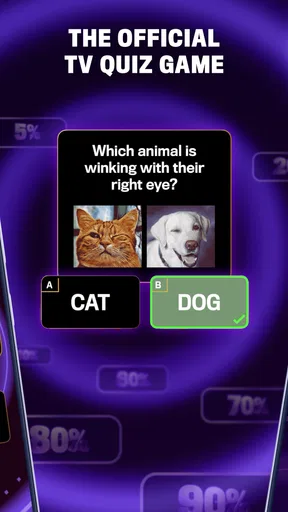
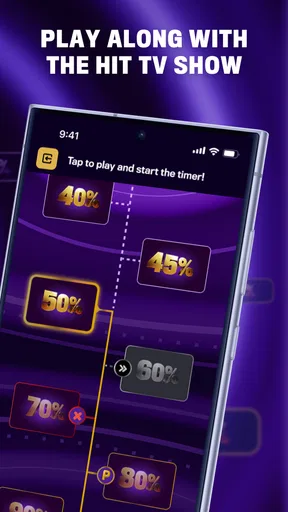
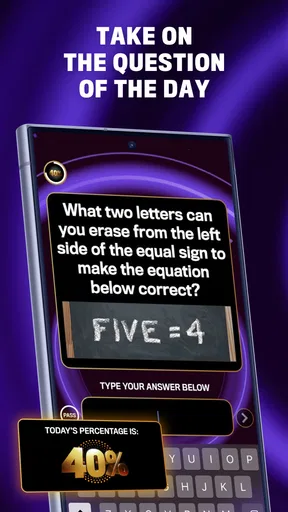
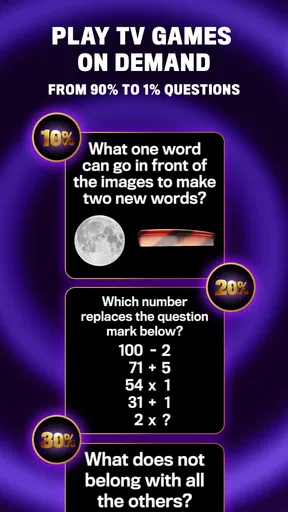
 Analysis by AppCompare
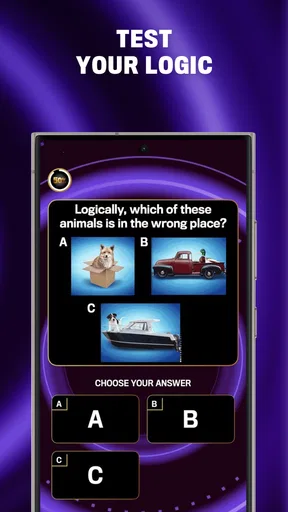
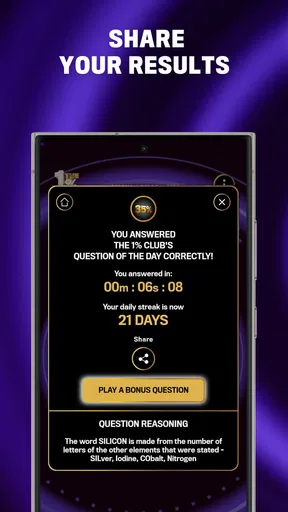
I found The 1% Club most interesting when I stopped treating it like a normal trivia app and started treating it as a test of how I think. Its central appeal is the TV-show quiz format: instead of simply asking for facts I may or may not remember, it presents questions that encourage me to examine wording, patterns, assumptions, and everyday logic. That gives each round a different feel from a conventional general-knowledge quiz.
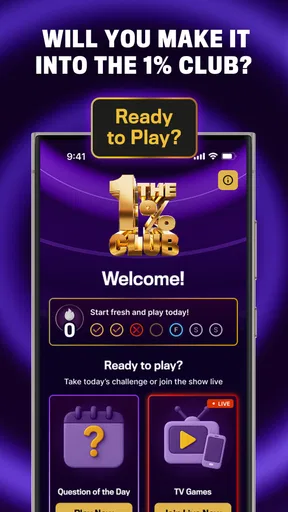
This is a free trivia game from Telescope Inc., aimed at Everyone and available for devices running Android 6.0 or later. It reached the store on May 15, 2024, and the current version is 2.0.0. The store summary describes it as a TV show trivia quiz built around the challenge of making it into The 1% Club, which is a useful way to understand its tone: the goal is less about collecting obscure facts and more about seeing whether I can solve questions that become progressively more demanding.
Why the question style matters more than the usual quiz format
The strongest capability here is the way the game turns a quiz answer into a small reasoning exercise. In many trivia games, I either know an answer immediately or I do not. That makes the experience depend heavily on memory. Here, the attraction comes from having a chance to work something out, even when the subject is unfamiliar.
That difference changes how I approach each question. I read more carefully, look for the detail that matters, and try not to choose an answer simply because it feels familiar. A question can appear easy at first and then become harder once I notice an unusual phrase or a misleading assumption. The game therefore rewards patience as much as quick recall.
The useful skill is not memorizing more facts; it is learning to challenge your first answer. That makes the game a good fit for short breaks when I want something more engaging than tapping through obvious choices. It also gives the experience a social quality, because two people can understand the same question differently and debate the reasoning before selecting an answer.
I would not describe it as a study tool, and I would not open it expecting the depth of a specialist quiz about history, science, sport, or entertainment. Its identity is broader and more puzzle-like. The TV-show framing supplies the sense of progression and pressure, while the questions themselves are what determine whether a session feels satisfying.
How a typical question feels in practice
When I play, the first useful habit is to slow down before touching an answer. The temptation in a quiz is to react to the most recognizable word, but that is exactly where a reasoning-based question can catch me. I get better results by reading the entire prompt once, identifying what it is really asking, and only then comparing the choices.
Worth Reading Before You Choose

EA SPORTS FC Mobile 26 Is a Bigger Football Game, but It Takes Time

Flipboard Shows What News Apps Must Do Beyond the Feed

Switching to Android Auto Means Rethinking Your Driving Routine

Google Calendar Makes a Crowded Week Easier to Manage

Ludo King Makes the Most of the Minutes Between Plans

Baby Panda World Brings Quick Play to Modern Phones, but Its Game Library Feels Busy
I also find it helpful to separate certainty from confidence. Sometimes I know the answer. In other cases, I merely recognize one option more quickly than the others. Those are not the same thing. The game becomes more interesting when I treat that distinction seriously, because a fast guess can be less reliable than a slower look at the structure of the question.
That approach makes it suitable for playing with another person. One player can read the question aloud while the other explains the reasoning, and the disagreement becomes part of the entertainment. It works especially well when neither player is trying to prove that they know everything. The better conversation is usually, “What detail made you choose that?” rather than, “How did you not know that?”
For solo play, I recommend using a simple mental routine: read, restate, eliminate, then answer. Restating the question in my own words helps me notice when I have misunderstood it. Eliminating clearly unsuitable options reduces the pressure to remember a perfect fact. This is a small adjustment, but it makes the game feel less random and gives wrong answers more value as feedback.
One trade-off is that this style can feel less rewarding if I want constant speed. Players who enjoy rapid-fire questions and instant confirmation may prefer a more traditional trivia app. The 1% Club is at its best when I am willing to spend a little longer on a question and enjoy the process of arriving at an answer.
A realistic use case: a short shared challenge at home
The most natural scenario for me is a casual evening with someone who likes quiz shows but does not necessarily want a complicated multiplayer game. I can open it during a break, pass the phone across, and turn a few questions into a friendly challenge. There is no need to prepare a topic list or agree on a specialist subject first. The broad format gives both players a chance to participate.
It also fits a family setting, with one important qualification: the Everyone age rating makes it approachable for a wide audience, but younger players may still need help with reading, interpretation, or questions that rely on abstract reasoning. The age label does not mean every question will be equally easy for every child. I would use it as a shared activity rather than assume that a child can enjoy every round independently.
Another good situation is a commute or waiting room, provided I am in the mood to concentrate. This is not the kind of game I would choose when I only have enough attention for repetitive tapping. Its main strength depends on noticing details, so interruptions can make a question feel unfair even when the issue is simply that I was distracted.
A useful group rule is to let everyone explain an answer before revealing whether it is correct. That keeps the focus on reasoning and prevents the fastest person from dominating every round. It also exposes an interesting weakness in my own thinking: I sometimes choose an answer because it sounds natural, while another player notices that the wording points somewhere else.
For a solo session, I would set a small personal goal instead of trying to play indefinitely. I might focus on avoiding impulsive answers, or on explaining why I rejected each option. That turns the game into a more deliberate mental exercise and avoids the flat feeling that can come from repeating the same kind of challenge without reflection.
Where it differs from ordinary trivia alternatives
Compared with a standard general-knowledge quiz, this game gives me more opportunity to reason my way forward. A conventional alternative is often better when I want to test a specific knowledge area, compare scores quickly, or answer a large number of short questions in succession. Those games can be more efficient for learning facts or measuring recall.
The 1% Club has a different payoff. I am not necessarily proving that I remember a date, name, or definition. I am testing whether I can interpret a prompt without jumping to the obvious conclusion. That makes the experience more accessible to someone who feels intimidated by specialist trivia, although it can also frustrate a player who wants every question to have a clearly factual answer.
It also differs from a pure puzzle game. A dedicated puzzle title usually builds around a consistent mechanic, while this quiz format can vary the type of thinking required from one question to the next. That variety keeps the TV-show concept lively, but it means I cannot rely on one strategy forever. If I find one question type comfortable, the next may ask me to approach the problem differently.
Against a live quiz show or a group trivia night, the app is more convenient but less socially rich. I can play whenever I have a few minutes, yet the phone cannot fully reproduce the energy of a room full of people reacting together. The best compromise is to use it as a conversation starter rather than as a replacement for every shared game night.
The published average rating is 3.2 from around 259 ratings, with roughly 120 written reviews. I read that as a sign that the game will appeal strongly to some players while leaving others unconvinced. That matches my experience of its focused design: if the reasoning-centered format clicks, it is enjoyable; if I mainly want fast factual recall, its central idea may feel like an obstacle.
The friction points I would consider before installing
The biggest limitation is the same feature that makes the game distinctive. Questions that depend on careful interpretation can feel satisfying when I understand the intended route, but irritating when I believe an alternative reading is reasonable. A traditional fact question usually gives me a clearer sense of why I was wrong. A logic-based question can leave more room for debate.
That means I would not recommend it to someone who dislikes ambiguity or expects every answer to be immediately obvious from a single piece of knowledge. The game asks me to accept that the challenge may lie in reading the question properly, not simply in knowing more than the person beside me.
Another trade-off is replay value. A quiz game depends on the quality and variety of its question pool, so my enjoyment can change as familiar prompts become easier. I would judge it as a title for recurring short sessions rather than a game I need to play continuously for long periods. That expectation makes the format feel more comfortable and avoids demanding endless novelty from it.
The free price makes trying it easy, especially for someone unsure whether this type of quiz will suit them. Still, free does not automatically mean it will fit every player. The real cost is attention: I need to read carefully, think through the wording, and accept that a round may not move at the speed of a rapid-fire quiz. If I want a background game that requires almost no concentration, I would choose something else.
Device compatibility is also worth checking before downloading. The game requires Android 6.0 or later, so it is not intended for every older Android handset. On a compatible phone, I would still make sure the screen is comfortable for reading, because the central challenge loses its point if I am rushing or struggling to see the question clearly.
I would also avoid judging it solely by how quickly I get through a session. The game is more rewarding when I review my reasoning after a mistake. If I simply tap, see the result, and move on, I miss the part that separates it from ordinary trivia. This is a title where the player’s approach has a noticeable effect on the quality of the experience.
Small strategies that make the challenge more rewarding
My first practical tip is to watch for the difference between a familiar answer and a justified answer. When one option stands out immediately, I ask myself what evidence supports it. If I cannot explain that choice, I reread the question. This two-second pause often prevents the kind of mistake caused by recognizing a pattern too quickly.
Second, I try to identify the question’s level of abstraction. Is it asking about a literal detail, a relationship between things, or the implication of a sentence? I do not assume that a question that looks like general knowledge should be answered from memory. Classifying the task before solving it gives me a better chance of selecting the right method.
Third, when playing with friends, I keep track of explanations rather than only correct answers. A player who reaches the correct choice for the wrong reason may struggle on a similar question later. Discussing the path to the answer turns a short quiz into a more interesting exercise in communication and critical thinking.
Fourth, I use mistakes to find personal habits. I may discover that I overthink simple wording, trust the longest answer, or choose the option that sounds most familiar. Those patterns are more useful to notice than a single score. The game provides a compact setting in which those habits become visible without making the session feel like formal training.
Finally, I recommend stopping after a satisfying round instead of forcing a long session. Because the appeal comes from concentration, tired play can make the questions feel more confusing than they really are. Short, attentive sessions suit the format better than treating it like an endless feed of disposable questions.
Who will get the most from The 1% Club?
I think this game is best for people who enjoy quiz shows, lateral thinking, and friendly arguments over the meaning of a question. It is particularly approachable for players who are not confident in specialist trivia but still like the feeling of solving a challenge. The Everyone rating also makes it a reasonable option for mixed-age groups, as long as an adult is ready to explain harder wording when necessary.
It is a good choice for a person who wants a free game to share during a short break, for a family looking for a lightweight thinking activity, or for a trivia fan who wants something less dependent on memorized facts. The current version, 2.0.0, gives the app a clear starting point for anyone considering it now, while the modest average rating suggests that expectations should remain realistic rather than assuming it will suit everyone.
I would skip it if my priority is specialist knowledge, competitive online play, a large collection of factual categories, or a relentlessly fast pace. A conventional quiz app will probably serve those needs better. I would also look elsewhere if I find wording-based challenges more annoying than entertaining, because that is not a minor detail here; it is the heart of the experience.
My final view is positive but specific. The 1% Club is not memorable because it tries to cover every kind of trivia. It works because it asks me to pause, question my assumptions, and explain why an answer makes sense. That focus gives it a clear personality and makes it easy to recommend to the right friend, especially someone who enjoys a clever question more than a long list of facts.
I would install it for casual shared play or thoughtful solo sessions, keeping in mind that the best results come from reading carefully rather than racing. If that sounds enjoyable, the free entry point makes it worth trying. If I want instant answers, specialist subjects, or a fully competitive quiz environment, I would choose a different game instead. For its intended audience, though, this is a pleasantly distinctive way to turn a familiar TV quiz idea into a small test of everyday reasoning.
Pros
- Covers questions from multiple episodes and topics
- Quick rounds make it easy to play during short breaks
- Progress tracking encourages regular play
- Suitable for fans who enjoy testing general knowledge
- Simple interface is easy to understand from the start
Cons
- Some questions may feel too easy for experienced quiz players
- Content can become repetitive after extended sessions
- Requires a stable connection for certain features
- May have limited appeal if you do not watch the TV show
- Scoring can feel frustrating when one mistake ends a run
FAQs for The 1% Club TV Show Quiz Game
What is The 1% Club TV Show Quiz Game?
The 1% Club TV Show Quiz Game is a trivia experience inspired by the television quiz format, where players answer questions designed to test logic, observation, and common sense rather than simple memorization. The challenges generally become more difficult as you progress, giving the game a competitive feel for solo players, families, and groups who enjoy testing how their thinking compares with other contestants.
How does the gameplay work in The 1% Club Quiz Game?
Gameplay typically begins with accessible questions before moving toward puzzles intended to challenge a much smaller percentage of players. You select or submit an answer within the available time, then review whether your reasoning was correct. The experience focuses on careful reading and quick decision-making, so rushing can lead to mistakes even when a question initially appears easy.
Can I play The 1% Club TV Show Quiz Game offline?
Offline availability may depend on the specific version of the app and the feature being used. Some quiz content may work without a continuous connection after installation, while advertisements, updates, leaderboards, account features, or online competitions can require internet access. It is best to check the app’s store listing and test the game before relying on it during travel.
Is The 1% Club Quiz Game suitable for children and families?
The game can be enjoyable for family quiz sessions because many questions test reasoning rather than specialist knowledge. However, suitability may vary according to the child’s reading ability, the difficulty of the puzzles, advertising, and any in-app purchase options. Parents should review the age rating, privacy information, and device settings before allowing younger players to use the app independently.
Does The 1% Club TV Show Quiz Game include ads or in-app purchases?
The app may include advertising or optional purchases, depending on the platform, region, and current release. Ads can appear between rounds or after completing a challenge, while purchases may offer extra content, remove advertisements, or provide other conveniences. Before downloading, review the store page for pricing details and consider enabling purchase restrictions if children use the device.


